

|
Getting your Trinity Audio player ready...
|
If there is one universal truth in the coatings industry, it’s this: paint failure is almost never caused by the paint itself. Whether you’re a homeowner planning a DIY refresh, a contractor working to deadline, or a retail professional advising customers, surface preparation is the single biggest determinant of paint performance, durability, and appearance. Skipping or rushing this stage may save time upfront – but it almost always costs more in repairs, callbacks, and reputational damage later. This article forms the foundation of the Ask the Expert – Surface Preparation Series, created for the Paint Club and Plascon Paint Expert ecosystem. It establishes the core principles that every subsequent topic builds on, from contaminants and moisture testing to primers and specialised substrates. If paint is the finish, preparation is the structure beneath it.
What Is Surface Preparation (Really)?
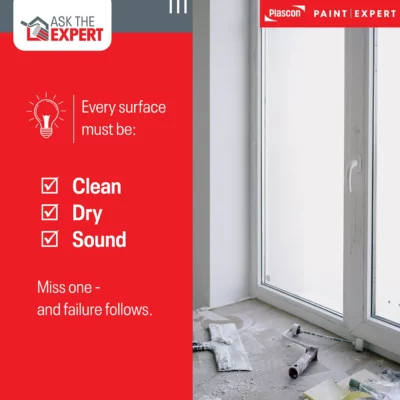
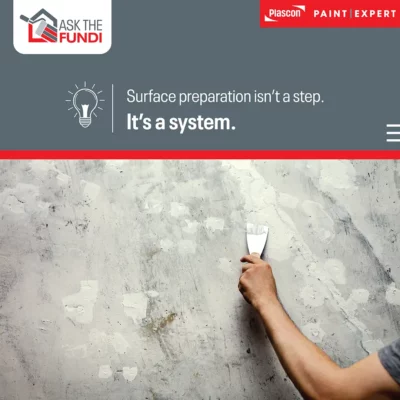
Surface preparation is not a single step. It is a systematic process that ensures the substrate is:
- Clean – free from contaminants that interfere with adhesion
- Dry – within acceptable moisture levels for coating
- Sound – structurally stable, well-bonded, and fit to receive paint
Only when these three conditions are met can a coating perform as designed. In professional specifications, this is often summarised as “clean, dry, and sound”, but each of these words carries far more technical weight than most DIYers realise.
Getting Back to Basics: Why Paint Systems Fail When Substrates Are Ignored
Expert insight: Fred Johnston One of the most common misconceptions in painting is that a coating system fails because of the paint itself. In reality, most paint failures begin long before a brush or roller ever touches the wall.
Paint systems fail when substrates are ignored. ~ Fred Johnston
Every surface has inherent limitations. Some are strong, stable and predictable. Others are porous, alkaline, moisture-sensitive or inconsistent by nature.
The role of a coating system is not to hide these limitations – it is to protect, stabilise and preserve the substrate beneath. ~Fred Johnston
At Paint Expert, our systems succeed because they start with substrate protection, not topcoat promises.
This is why the true cost of paint is never measured at the till. It is measured over time – in durability, appearance retention, and how long the system performs before maintenance or repainting becomes necessary.

Understanding Substrates: Not All Surfaces Are Equal
To prepare a surface correctly, you must first understand what you are working with. Building substrates can broadly be divided into two categories:
- Manufactured Substrates (Controlled Environment Production) These substrates are produced under factory-controlled conditions, which means their composition and performance are generally consistent and predictable. Examples include:
- Gypsum boards
- Fibre-cement boards
- Pre-manufactured panels
- Pre-coated metal substrates
Because these materials are made under controlled conditions, their limitations are known, and preparation systems can be specified with a high degree of confidence.
- Site-Made (In-Situ) Substrates Site-made substrates are formed, mixed and cured on site. Their performance is influenced by a wide range of variables, many of which are outside the control of the paint applicator. These variables include:
- Water content and curing time
- Weather conditions during application and curing
- Workmanship and consistency
- Environmental exposure over time
Common examples include:
-
- Cement plaster
- Concrete
- Brickwork and blockwork
Because site-made substrates are inherently variable, they demand proper diagnosis before any paint system is specified.
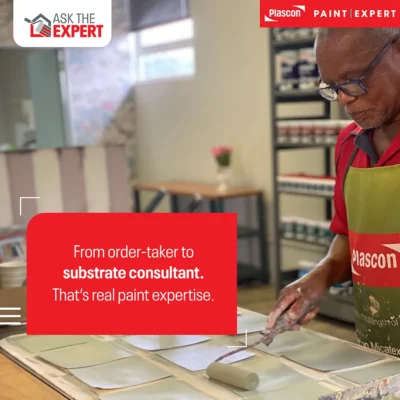
From Order-Taker to Substrate Consultant
This is where the real difference between paint retail and paint expertise lies.
If surface preparation is reduced to a product choice, price becomes the default differentiator. When price leads, failure usually follows. ~ Fred Johnston
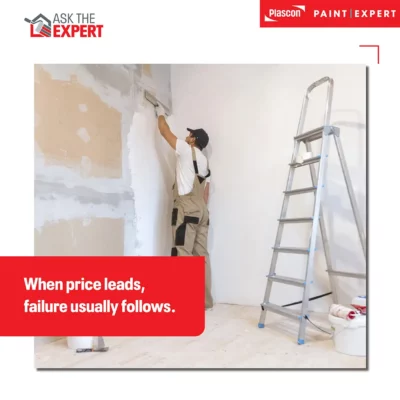
At Paint Expert, we believe the role of the paint specialist is to move from order-taker to substrate consultant – helping customers understand what their surface needs before recommending a system.

Before any primer or coating is selected, the following minimum diagnostic questions should be answered: Minimum Substrate Diagnostic Questions
- What is the substrate?
- Is it site-made or manufactured?
- Is the application interior or exterior?
- What is the age of the substrate and has it cured sufficiently?
- What level of environmental exposure will it face (C3 / C4 / C5)?
If these questions are not asked, primer selection becomes guesswork – and primer price becomes the deciding factor instead of system performance. ~ Fred Johnston
Why This Matters
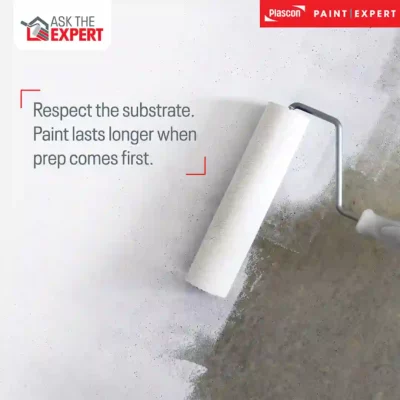
Correct surface preparation is not about over-engineering a job or selling unnecessary products. It is about respecting the substrate and choosing a system that works with it – not against it. When preparation is done correctly:
- Paint adheres better
- Coatings last longer
- Failures are dramatically reduced
- The full value of the paint system is realised
This philosophy underpins every article in our Ask the Expert: Surface Preparation Series – because long-lasting paint performance always starts below the surface.
Why Surface Preparation Determines Paint Longevity
Adhesion Starts at the Surface
Paint does not “soak into” a surface in the way many people imagine. Instead, it relies on mechanical grip and chemical bonding. Dust, grease, chalking, salts, or residual moisture all act as separation layers between the coating and the substrate. Even premium coatings cannot compensate for a compromised surface. Real-world insight (Paint Expert stores): The majority of complaints logged at retail level – peeling, blistering, flaking, and uneven finish – can be traced back to inadequate surface preparation, not incorrect product choice.
Environmental Stress in South Africa Raises the Stakes
South African conditions amplify preparation failures:
- High UV exposure accelerates breakdown on poorly bonded coatings
- Coastal salt air introduces hygroscopic salts that attract moisture
- Seasonal rainfall and humidity increase moisture-related failures
- Temperature swings stress weak adhesion points
A surface that looks “dry enough” may still be holding moisture below the surface -particularly on plaster, masonry, and concrete.
The Core Principle: Clean, Dry, Sound
1. Clean – Removing What You Can’t Paint Over Contaminants are not always visible. Common examples include:
- Atmospheric dirt and pollution
- Grease, oils, and cooking residues (especially kitchens)
- Mould, algae, and fungal spores
- Efflorescence salts on masonry
- Chalky residue from degraded previous coatings
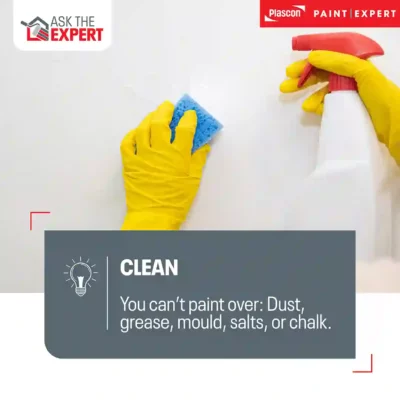

Painting over contaminants traps them beneath the coating, where they continue to interfere with adhesion. Key professional practice:
- Cleaning is not cosmetic – it is chemical and mechanical preparation. Depending on the surface, cleaning may involve:
- Washing with appropriate detergents
- Biocidal treatment for mould and algae
- Mechanical abrasion or scraping
- Thorough rinsing and drying
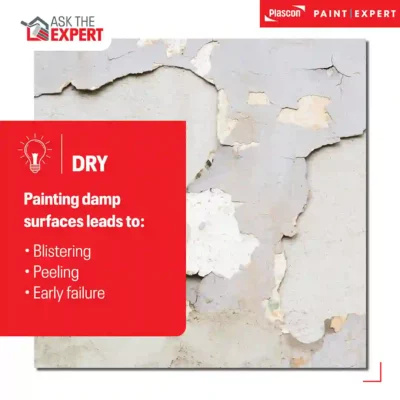
- Dry – Moisture Is the Silent Coating Killer

- Moisture is one of the most misunderstood aspects of surface preparation. A surface can appear dry to the touch while still retaining unacceptable internal moisture levels. Painting over damp substrates can result in:
- Blistering as moisture vapour pushes through the film
- Loss of adhesion
- Efflorescence migration through the coating
- Premature coating failure
- Sound – Stability Before Aesthetics
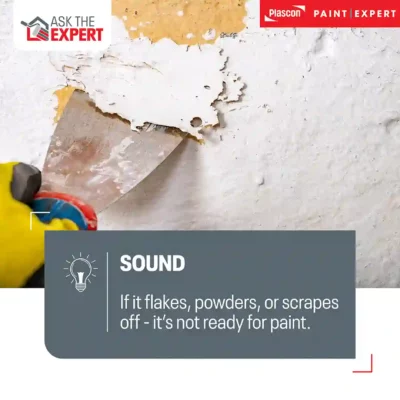
A surface must be structurally sound before paint is applied. This includes:
-
- No loose or friable plaster
- No flaking or delaminating previous coatings
- Cracks properly repaired
- Powdery or chalking surfaces stabilised
Paint is not a repair material. Applying coatings over unstable substrates simply hides the problem – temporarily.
Expert insight: If material can be removed with light scraping or brushing, it is not sound enough to paint.
What Happens When Preparation Is Skipped
Common Failure Modes Caused by Poor Prep
Poor surface preparation leads to predictable outcomes:
- Peeling and flaking – due to poor adhesion
- Blistering – moisture or solvent entrapment
- Uneven sheen or patchiness – inconsistent substrate absorption
- Early colour fade – weakened film integrity
- Mould regrowth – untreated biological contamination
These failures often appear within months, not years.
From a professional perspective, every failure costs twice: once to fix the problem, and once in lost trust.
Common DIY Surface Preparation Mistakes
“It Looks Fine” Assumption
Visual inspection alone is insufficient. Many preparation issues are invisible until failure occurs.
Skipping Drying Time
Rushing between washing, repairs, and painting traps moisture below the coating.
Painting Over Chalky Surfaces
Chalking must be removed or stabilised. Paint applied over chalk will bond to the powder – not the wall.
Using Primer as a Shortcut
Primer is not a substitute for preparation. It is a component of a prepared system, not a fix-all. 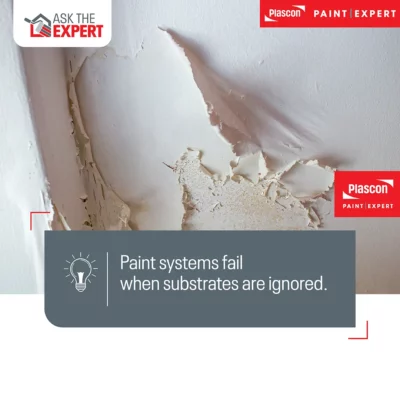
Professional Preparation Checklist
Before any coating is applied, confirm:
- Surface is free from dirt, grease, salts, and biological growth
- All cleaning agents are fully rinsed and dried
- Moisture levels are within acceptable limits
- Loose material has been removed
- Cracks and defects are properly repaired
- Surface porosity is assessed
- Correct primer or sealer is specified
This checklist applies whether you’re painting:
- Interior walls
- Exterior plaster
- Ceilings
- Bathrooms and kitchens
- Boundary walls
Click here to view our range of surface preparation products: PRIMERS & UNDERCOATS
Why Surface Prep Is Central to the Ask the Expert Series
This article intentionally sets the baseline. Every future topic – moisture, contaminants, primers, problem surfaces – builds on these fundamentals. Without preparation:
- The best coating will underperform
- Warranties may be compromised
- Visual quality will suffer
- Lifespan will be shortened
Surface preparation is not optional. It is the first specification decision. 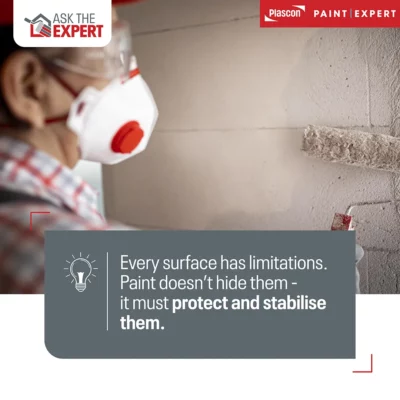
Summary: Paint Performance Starts Before the Paint Tin Is Opened
Surface preparation is the unseen work that determines everything that follows. Done properly, it:
- Extends coating life
- Improves finish quality
- Reduces failures and callbacks
- Protects both investment and reputation
For homeowners, it means fewer repaints. For contractors, it means fewer disputes. For retailers, it means fewer complaints. And for the Paint Club / Paint Expert ecosystem, it reinforces what the brand stands for: expertise, guidance, and doing it right the first time.
FAQs: Surface Preparation Fundamentals
- Why is surface preparation so important before painting? Because paint adhesion, durability, and appearance all depend on the condition of the surface beneath it.
- Can good paint compensate for poor preparation? No. Even premium coatings will fail if applied to contaminated, damp, or unsound surfaces.
- What does “clean, dry, and sound” really mean? It refers to a surface free of contaminants, within acceptable moisture limits, and structurally stable.
- How do I know if my wall is too damp to paint? The only reliable method is moisture testing. Visual checks are not sufficient.
- Is washing a wall enough preparation? Washing removes surface dirt but does not address moisture, chalking, or structural defects.
- Why does paint peel even when it looked fine at first? Adhesion failure often occurs beneath the surface and only becomes visible weeks or months later.
- Should I always use a primer? Primers are used when required by the substrate – not as a universal step. Correct diagnosis comes first.
- What is the most common DIY prep mistake? Underestimating moisture and painting too soon after cleaning or repairs.
- How long should a prepared surface last before repainting? When correctly prepared and coated, many surfaces can last years longer than poorly prepared ones.
- Can I get help choosing the right prep system? Yes. Paint Expert stores can assist with professional surface assessment and product specification: www.paintexpert.co.za
Disclaimer
This article is intended for general informational and educational purposes only. While it reflects industry best practice and professional experience, it does not replace a site-specific assessment or professional specification. Always consult a qualified paint professional or Paint Expert store for guidance tailored to your specific surface and environment.
For more information or to speak to an expert, contact us: info@paintexpert.co.za or whatsapp us on 082 638 3011
