

|
Getting your Trinity Audio player ready...
|
If paint systems could speak, most failures would tell the same story:
“The problem started before the paint ever went on.”
Peeling, flaking, patchy sheen, early chalking and moisture blistering are not decorative paint problems. They are substrate and primer failures. And in South Africa – with our high UV index, aggressive alkalinity, moisture movement, and thermal cycling – these failures are amplified.
Insights and technical framing are informed by decades of applied coatings experience, including contributions from Fred Johnston, Paint Club’s Training & Technical Manager, whose 30+ year career spans product development, failure analysis, and real-world system specification.
The key message is simple but often ignored:
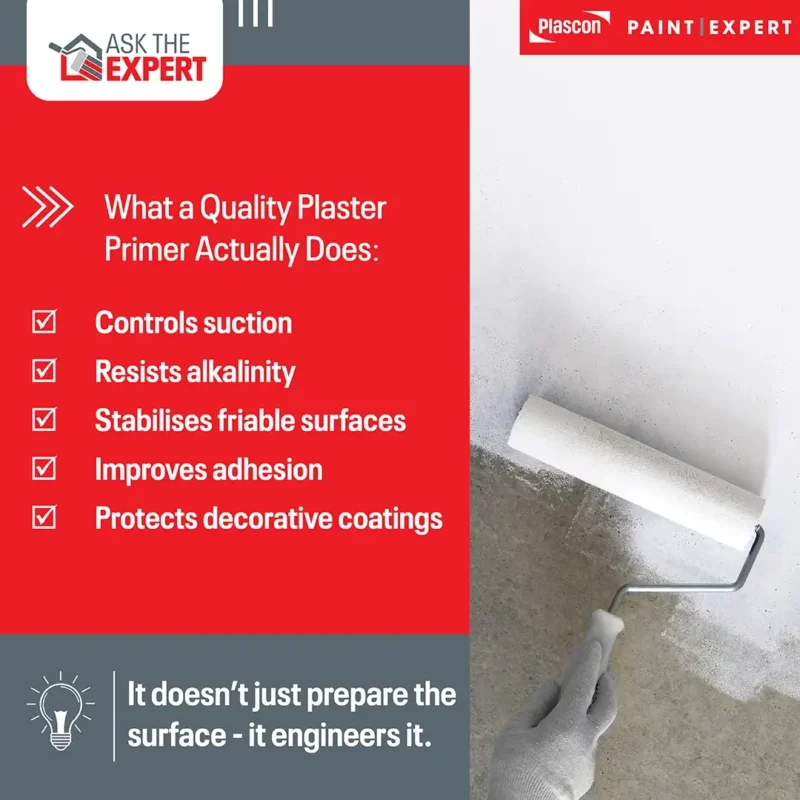
The primer does not prepare the surface.
It engineers it.
Why Primers Are Widely Misunderstood
Primers are often viewed as:
- A compulsory extra
- A cost to be minimised
- A generic “sealer”
This misunderstanding is reinforced by market strategies that deliberately promote cheap, non-specific primers to attract DIY and contractor foot traffic – regardless of technical suitability.
The result?
Primers are de-engineered, systems are broken, and long-term coating performance becomes irrelevant.
The Industry Disconnect
Primers are universally acknowledged as necessary, yet:
- Substrate knowledge is limited
- Sales conversations default to price
- Coating systems are treated as mix-and-match
This disconnect is where failure begins.
What a Plaster Primer Is Actually Designed to Do
A plaster primer is a functional engineering layer within a coating system.
According to Fred Johnston:
“Our primers do not simply prepare a surface, they engineer it. Plascon primers are designed around the weaknesses of real substrates and the environments they exist in, ensuring the coating system performs as intended for the full life cycle of the asset.”
The Inherent Problems with Plaster Substrates
Plaster is not inert. It is chemically and physically active – often long after it looks “dry”.
Common Inherent Plaster Deficiencies
Substrate-related
- High and variable porosity
- Free lime and residual alkalinity (often pH >10)
- Capillary moisture movement
- Surface friability and dusting
- Micro-cracking from shrinkage and thermal stress
Environment-related (South Africa)
- Moisture ingress (rain, coastal humidity, rising damp)
- Alkali attack on decorative coatings
- UV-driven thermal cycling on exteriors
A primer must manage all of these simultaneously.
Why There Are So Many Plaster Primers
Because plaster conditions are not uniform.
Plascon primers are designed substrate-first, not price-first. Each exists to solve a specific failure risk.
How to Select the Best Primer for Your Project
Choosing the correct plaster primer is not about brand loyalty or price point, it is about matching the primer to the substrate, environment, and coating system.

Before selecting a primer, a professional specification will always assess four critical factors:
- Substrate Type
• New cement plaster
• Old or weathered plaster
• Gypsum board or skimmed surfaces
• Mixed or previously coated substratesEach of these behaves differently in terms of suction, alkalinity, and surface stability. - Substrate Condition
• Is the surface chalky or friable?
• Is there visible dusting?
• Is the plaster fully cured?
• Are there signs of moisture movement or hairline cracking?Primers are selected to correct deficiencies, not merely coat over them. - Environment
• Interior vs exterior
• Coastal vs inland
• High-humidity or damp-prone areas
• Direct UV exposureSouth African conditions are aggressive by global standards, and primers must be specified accordingly. - Full Paint System
Primers are not standalone products. They are designed to work as part of a complete paint system, chemically matched to the decorative topcoats that follow.
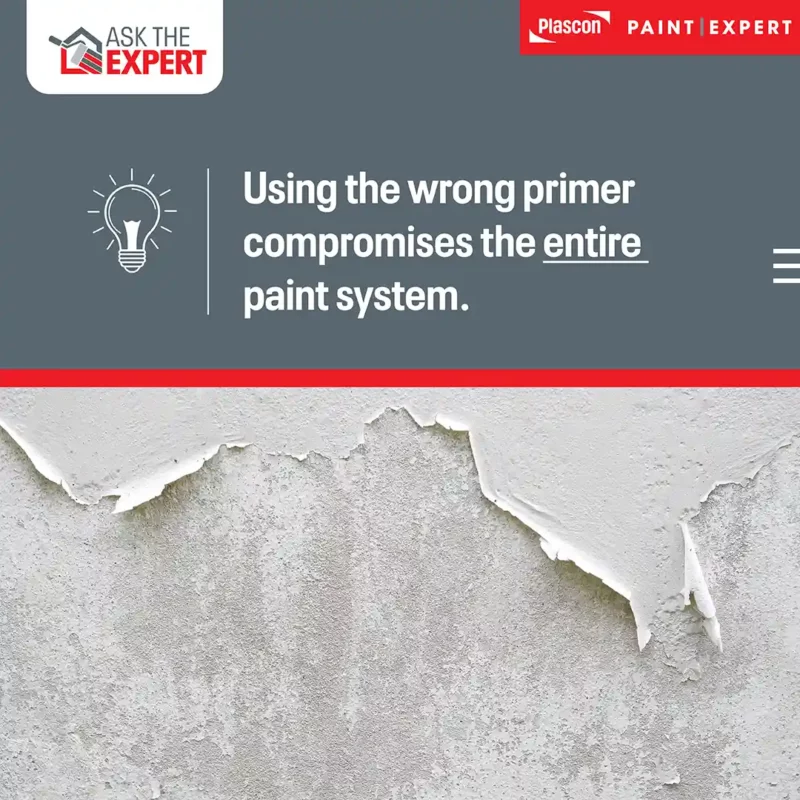
Using the wrong primer – even if it “looks fine” – can compromise adhesion, durability, and manufacturer performance guarantees.
When in Doubt: Get a Professional Specification
If you are unsure which primer to use, don’t guess.
Paint Club member stores are authorised Plascon Paint Expert retailers and offer professional, substrate-based guidance. For larger or more complex projects, a formal paint specification can be done to ensure:
- Correct primer selection
- Correct system build-up
- Long-term performance and value
This is where real cost savings are achieved – not at the till, but over the life of the coating.
Click here to enquire about our Paint Specification Service.
Bonding Liquid vs Primer: When (and When Not) to Use It
Bonding liquid is one of the most misunderstood products in the coatings environment.
What Bonding Liquid Actually Is
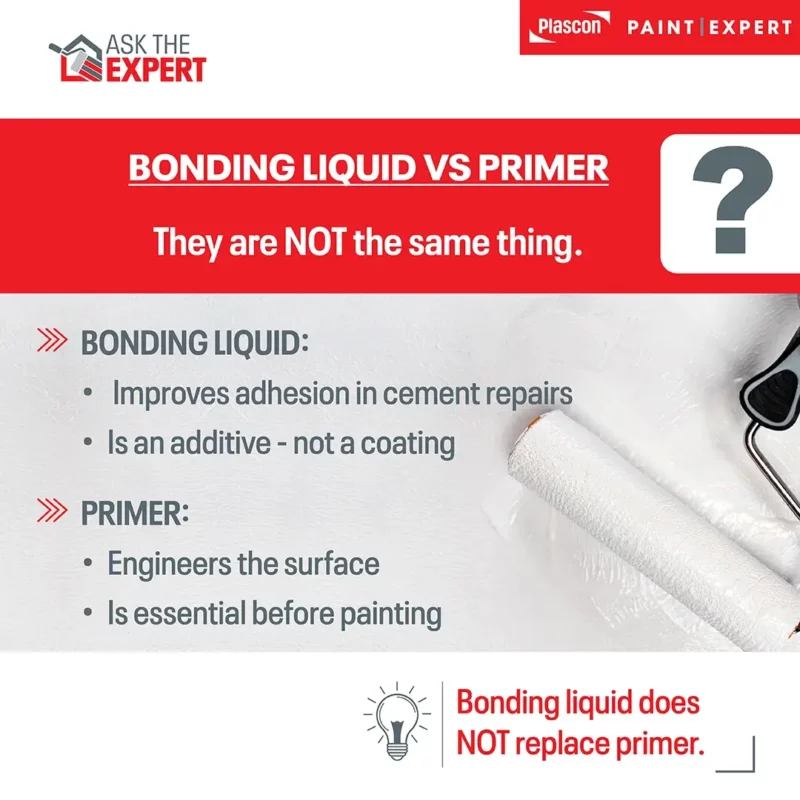
Bonding liquid is a polymer additive, not a primer.
It is designed to:
- Improve adhesion between cementitious materials
- Reduce porosity in masonry mixes
- Enhance flexibility in plaster or screed repairs
When Bonding Liquid Is Appropriate
Bonding liquid may be used:
- As an additive in plaster or screed mixes
- To improve adhesion between old and new cementitious layers
- In specific surface repair scenarios before priming
Bonding Liquid Is Not a Substitute for Primer
Bonding liquid:
- Does not provide alkali resistance
- Does not engineer surface porosity
- Does not replace a plaster primer
- Is not designed to receive decorative coatings directly
Using bonding liquid in place of a primer is a common shortcut – and a frequent cause of paint failure.
In a correct system:
- Bonding liquid may be used during repair
- Primer is still required before painting
They perform entirely different functions.
Primer vs Undercoat: Understanding the Difference
Another common area of confusion is the difference between primers and undercoats.
What a Primer Does
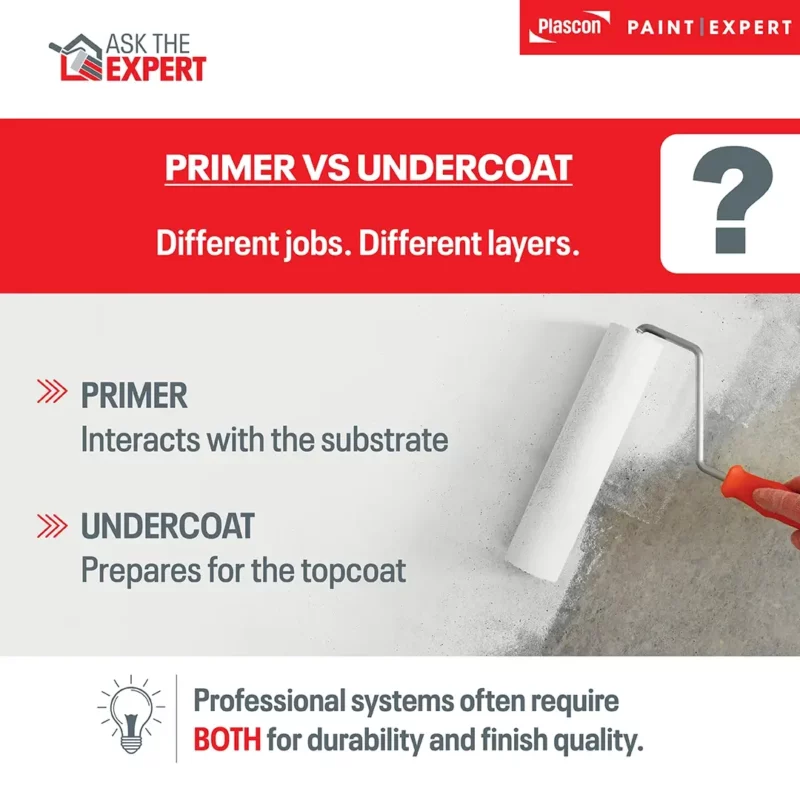
A primer is designed to interact with the substrate.
Its primary functions are to:
- Control porosity and suction
- Improve adhesion
- Provide alkali resistance where required
- Stabilise friable or dusty surfaces
- Create chemical compatibility between substrate and system
Primers are applied first and are substrate-specific.
What an Undercoat Does
An undercoat is designed to interact with the topcoat, not the substrate.
Its primary functions are to:
- Improve opacity and colour uniformity
- Build film thickness
- Enhance finish quality
- Reduce the number of topcoats required
Undercoats are applied after priming and before finishing coats.
When You Need Both
In most professional paint systems:
- Primer – engineers the substrate
- Undercoat – prepares for the finish
- Topcoat – provides colour, durability, and aesthetics
Skipping or substituting these layers may appear to save money – but almost always reduces system lifespan.
Why This Matters: The Cost of Getting It Wrong
Using:
- Bonding liquid instead of primer
- Undercoat instead of primer
- Cheap, non-specific primers
…results in systems that:
- Fail prematurely
- Require earlier repainting
- Cost more over time
- Undermine the performance of even the best topcoats
This is why professional specifications focus on value over price and life cycle costing, not short-term savings.
Expert Tip: One Conversation Can Save Years of Repainting
If your project involves:
- New plaster
- High-alkali conditions
- Exterior exposure
- Coastal or damp environments
- Commercial or high-traffic areas
Speak to your nearest Paint Expert store and request professional advice or a specification.
Correct primer selection is not an upsell – it is asset protection.
Plascon Plaster Primers – Categories, Intent & SKUs
- High-Alkali & New Cement PlasterUse case:• Fresh cement plaster
• High pH surfaces
• Early curing environmentsKey requirement:Alkali resistance, controlled penetration, chemical stability.
Relevant products:
• Plascon Professional High Alkali Plaster Primer – 20L
SAP: PP000950-0020
- General Plaster & Masonry (Interior / Exterior)Use case:• Sound plaster
• Balanced porosity
• Standard residential and commercial workKey requirement:Uniform suction control, adhesion promotion, system compatibility.
Relevant products:
• Plascon Plaster Primer – 1L / 5L / 20L
SAP: UC000056-0001 / UC000056-0005 / UC000056-0020
• Paramount Plaster Primer – 20L
SAP: PPW000001-0020
• Master Prep Water-Based Plaster Primer – 5L / 20L
SAP: UC000020-0005 / UC000020-0020
- Gypsum & Highly Absorbent SurfacesUse case:• Rhino board
• Gypsum plaster
• Drywall systemsKey requirement:
Deep penetration without surface skinning.Relevant products:
• Plascon Professional Gypsum & Plaster Primer – 5L / 20L
SAP: PP000700-0005 / PP000700-0020
• Plascon Prime-All Gypsum & Plaster Primer – 1L / 5L / 20L
SAP: UC000010-0001 / UC000010-0005 / UC000010-0020
- Multi-Surface & Versatile Primer SystemsUse case:
• Mixed substrates
• Renovations
• Controlled DIY applicationsKey requirement:
Broad adhesion spectrum with defined limitations.Relevant products:• Easy Living Total Prime – 20L
SAP: EUP000001-0020
• Plascon Multi-Surface Primer – 1L / 5L
SAP: WUP000001-0001 / WUP000001-0005
• Plascon True Colour Primer, Sealer & Undercoat – 5L / 20L
SAP: PSU000001-0005 / PSU000001-0020
- Trade & Contractor Primers (Controlled Use)Use case:• Volume work
• Cost-sensitive projects with correct specification disciplineKey requirement:
Correct application within defined limits – not substitution.Relevant products:
• Plascon Professional Contractors Plaster Primer – 5L / 20L
SAP: PP000300-0005 / PP000300-0020
• Easy Living Total Prime – 5L & 20L
SAP: EUP000001-0005 / EUP000001-0020
• Plascon TradePro Water-Based Primer – 5L / 20L
SAP: UWP000001-0005 / UWP000001-0020
• Plascon TradePro Solvent-Based Primer – 5L / 20L
SAP: USP000001-0005 / USP000001-0020
How Plascon Plaster Primers Engineer Performance
Plascon primers are not cost-reduced entry products. They include:
Ultra-Fine Penetrating Acrylic Binders
- Seal excessive suction without surface skinning
- Enable consistent film build of decorative coats
Hardening Polymers
- Increase surface cohesion
- Reduce dusting and friability
Low Film-Build Resin Design
- Prevents re-emulsification
- Maintains adhesion under moisture stress
These components are expensive, which is why they are absent in cheap primers.
Why Cheap Primers Fail (And Why They Keep Being Sold)
Cheap primers exist because:
- They look acceptable on day one
- They reduce basket price
- They attract traffic
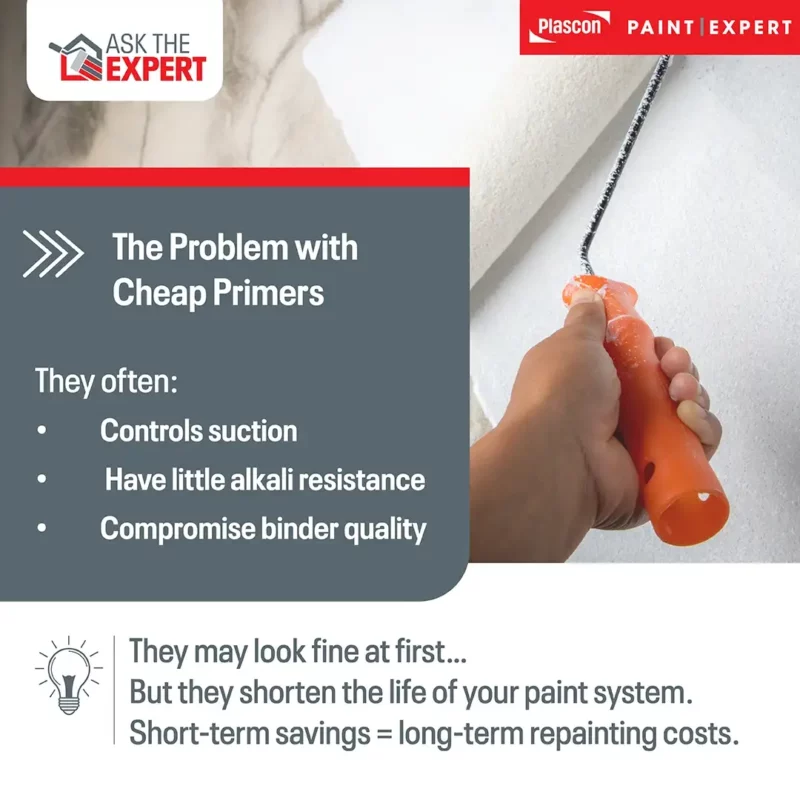
They fail because:
- Penetration is limited
- Alkali resistance is compromised
- Binder quality is reduced
- Moisture tolerance is poor
This leads to false economy.
Life Cycle Costing: The Only Metric That Matters
Short-term savings on primers almost always result in:
- Earlier repaint cycles
- Higher maintenance costs
- Loss of asset value
Repainting costs exponentially more than priming correctly once. ~ Fred Johnston
Why Primers Dictate the Entire Paint System
Primers:
- Lock in chemical compatibility
- Control moisture movement
- Protect decorative coatings from substrate attack
Substituting primers compromises:
- Adhesion
- Moisture control
- Alkali resistance
- Film integrity
- Durability
Conclusion: Value Over Price Is Not Optional
Primers are not where you save money.
They are where you protect it.
Plascon plaster primers exist to engineer predictable, long-term performance in real South African conditions – not to compete in a race to the bottom.
When primers are reduced to price points, coating systems fail.
When primers are specified correctly, assets last longer, look better, and cost less over time.
FAQs
- Why can’t I use a generic primer on plaster?
Because plaster varies chemically and physically. Generic primers do not address alkalinity, porosity, or moisture movement adequately. - Is a more expensive primer really worth it?
Yes. It reduces repaint cycles and long-term maintenance costs. - Can I skip the primer if the plaster looks fine?
No. Appearance does not indicate chemical stability. - Why are there so many Plascon plaster primers?
Because different substrates require different engineered solutions. - Are trade primers lower quality?
They are application-specific and must be used within defined technical limits. - What causes paint to peel on plaster?
Usually primer failure – not topcoat failure. - Can I mix primer brands with topcoats?
Performance guarantees generally apply only when systems are used as specified.
Contact us for a specification for your next project: www.paintexpert.co.za - How do I choose the correct primer?
Assess substrate condition, environment, and coating system – or consult a Paint Expert.
Disclaimer
This article is intended for general educational purposes only. While based on extensive industry experience and technical input, it does not replace professional site assessment or manufacturer specifications. Always consult product data sheets and qualified paint professionals for project-specific advice.
